BE GONE DAEMON
Milli Kaundilya
FY BSc. Economics (2025 – 29)
Estimated Reading Time ~ 5 minutes
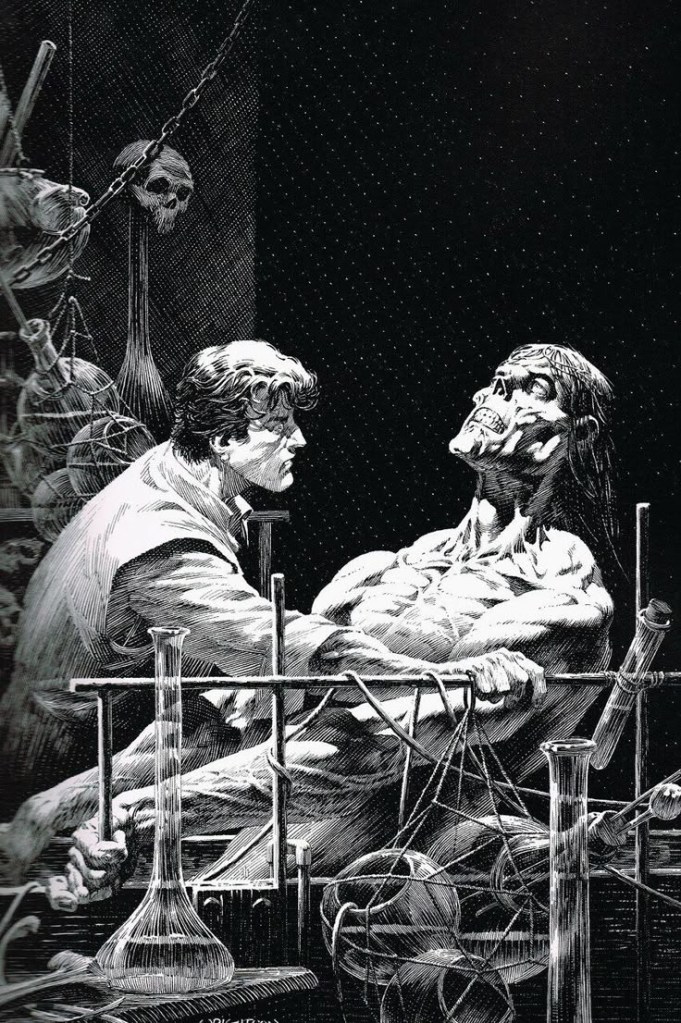
Usually, when a movie adaptation comes out, I like to read the book prior to the movie’s release so that I can point out and criticize every little fault and inconsistency in the plotline (The Count of Monte Cristo was a three-hour nightmare). A few days ago, I finished reading one of the most thought-provoking books I have ever read – Frankenstein. The 1818 novel by Mary Shelley narrates the story of an ambitious, young man, charmed by the ancient chimerical disciplines of science, who defies the laws of nature to create a living being; in due time, the consequences of this scientific endeavour will go on to seal the fate of this man and his loved ones to a grim demise.
Due to the moral complexity of this work, I will only discuss three analogous themes: the supremacy of beauty over matter, the corruption of innocence, and the moral greyness of human nature.
In today’s day and age, society has come to accept the uniqueness of the human body. People of different sizes, races, and mannerisms exist harmoniously with growing acceptance. Even the world’s tallest man is viewed as a wonder rather than an anomaly. Unfortunately, this was never the case for the daemon (Frankenstein’s creation). When Victor Frankenstein created his “human”, he harvested the most beautiful corpses to create a being of magnificence. However, as with many aspects of his life, things went terribly wrong. He purposefully made the daemon freakishly large to allow room for any adjustment in his calculations. In the end, the daemon was an enormous being with a petrifying countenance, scaring everyone (even his creator) in his path. It was a face even a mother could not love.
To make up for his terrifying visage and distorted bodily proportions, the daemon devoted himself to years of studying and observing the ways of humankind – their interactions, mannerisms, and even emotions. He longed for society to look past his wretched face and accept him for the love and kindness he could give to the world. All he desired was a human connection. Yet, he was scorned and abused by everyone. Even the children, a symbol of impartiality and naivety, were scared by the daemon. All he wanted was kindness, love, and affection—traits that define humanity. He was more human than most people on this earth.
But what happens to us if we are only fed cruelty our entire life?
The daemon resisted the bitterness within him. At merely five years old, he was an inexperienced being in the language of emotion, having never been taught how to navigate the turmoil within him. After a period of denial, his innocence faded into hatred. When his countless attempts at integrating into society were only met with rejection and scorn, he went on a murderous rampage, destroying all who stumbled onto his path. While this was highly ironic, given how he never understood how man would murder someone of his own kind, he did express remorse for his actions – a fragment of his moral conscience had still survived.
Essentially, I ask the most important question in Frankenstein: Who is the real antagonist?
Victor Frankenstein, a man who hated the simplification of modern science, ignored every warning in pursuit of greatness. He knew that he wanted to be remembered in history. However, unaware of the consequences, Frankenstein abandoned his creation because he was frightened; he never would have thought in a million years that his idea would actually materialise. In the real world, the likelihood of your sci-fi fantasy actually coming to life is very small, and even if you work towards it, you would never expect it to actually come true. When our wildest dreams come true, we often recoil from it, unable to bear the consequences and too fearful to face the cost of ambition – perhaps because facing it would crush our collective spirit.
I understand why Frankenstein abandoned his creation. But not being able to go through this entire ordeal, which he initiated, proves that Frankenstein was a coward and not a true scientist.
Had he actually shown any emotional and moral support for the creature, we would have an entirely different story where Frankenstein would have helped the creature assimilate into society, where he would be loved and accepted by all eventually. Frankenstein would have grown to be a renowned scientist, known for bending the laws of nature, which would have led to the revival of ancient scientific disciplines (obviously, there would be moral and scientific repercussions for breaking the laws of nature, but that is for another time). Nevertheless, hoping for an alternative ending is not for the faint of heart. The character of Frankenstein is a rather complex and scrupulous one and is popularly known as a morally grey character—- characters that often perform both good and bad actions, blurring the line between the two.
Jack Sparrow, the iconic protagonist of Pirates of the Caribbean, embodies a fascinating mix of self-interest, cunning, and occasional altruism, making him a morally ambiguous character. He frequently lies and manipulates others to achieve his goals, often escaping danger through trickery rather than courage. Yet, despite his selfish tendencies, Jack operates according to a personal moral code: avoiding unnecessary violence and occasionally showing loyalty to his allies. His fluid ethics make him unpredictable — an antihero who can switch between charming opportunist and reluctant saviour. He is a true example of survival of the fittest. In essence, he demonstrates that morality can be pragmatic, situational, and intimately tied to survival and identity. It is refreshing to see a complex character like Jack Sparrow, when pirates are widely known to be treasure-loving scallywags who leave all men behind.
The privilege of being morally grey often belongs to those in positions of power or wealth — individuals whose social standing allows them to transgress boundaries without facing the same consequences as others. Characters such as Frankenstein, Michael Corleone and even Jay Gatsby exemplify how the upper class can afford moral complexity. In the case of Frankenstein, his wealth and social standing allow him to pursue his scientific creativity without the necessary accountability required if the experimentation goes awry. His remorse is self-centred on his guilt rather than on the number of lives lost due to his intellectual creation. His status and wealthy upbringing allow him to get away with the crimes he has committed. In contrast with the daemon, he can not afford mistakes or moral wavering; every blunder reinforces his monstrous image. Especially, back in that time period, it was easier for the lower class to be convicted for the crimes of the upper class with little to no evidence whatsoever— a classic example of systemic corruption.
What about the daemon? Would he be considered a morally grey character?
Unlike Frankenstein, the daemon would be considered a morally conflicted character– people struggling to choose between two or more competing values. In the beginning, the daemon never understood why humans performed malicious acts towards their own kind. He found it to be barbaric and remorseless. As time went on, the daemon longed for human connection and warmth. He spent hours studying human nature so that his kindness and articulation would overlook his disfigured, patched face. He still maintained the belief that if adults would not love him, then children might. When none of that worked out, he begged his creator to create a female companion of his stature just to be able to feel the warmth and loveliness of connectivity. Every person in his life has rejected him for the one thing he desired the most– the warmth of affection.
His creator was on the verge of creating a female creature just like him, but in the end destroyed it out of fear of carnage and distrust. Personally, if I were the daemon, I too would bend my morals and go on a murderous rampage, making sure no one gets the happiness they deserve. Unlike Frankenstein, the daemon feels remorse for all the lives he took out of revenge. In the end, despite his love for nature and life, he must sacrifice himself because he can not control his vengeful impulses.
A secondary thought did emerge in my head when I was reading this novel: How are today’s morally grey characters compared to those in the past?
In today’s modern literature, morally grey characters have become synonymous with the dark romance and smut booktok community. Morally grey characters today are described as being 6’5 dark and broody, with tattoos all over their body. They have some high-paying, dominating jobs like a mafia boss or the CEO of a Fortune 500 company. Usually, in these tropes, the female character is weak and submissive, who gives in to every sexual whim that the male character desires, no matter how degrading it is. They are described as morally grey because they violently disfigure every person who even talks to the female lead, while simultaneously performing acts which is borderline sexual assault. An amazing example of this would be Haunting Adeline, a story about a girl who lives in her inherited mansion and is being stalked by a guy madly in love with her.
These characters aren’t actually considered to be morally grey because their reactions to certain situations don’t prompt us readers to think about whether what they did was right or wrong. Just because moral subjectivity exists does not mean moral objectivity is a hidden concept in literature. The booktok definition of a morally grey character is a man who assaults countless innocent (and maybe guilty) people to “protect” his “butterfly”.
I, for one, do not understand why we need to think about this when our innate sense of moral objectivity already knows that it is wrong and extremely concerning to be acting in this manner.
It is quite saddening to see modern literature have such a misinterpreted and ignominious way of writing complex, morally grey characters. When I finished reading this book, I was heartbroken with the way everyone treated the daemon. Unfortunately, that being said, I too would have been scared of the daemon just like everyone else in the novel. It is hard for humans to see the amount of effort or the thoughts that are rushing through the minds of others at all times. It is truly difficult to formulate empathy for anyone in a flickering moment. Despite all of this, I have grown to love Frankenstein as a testament to what it truly means to be human.
This is actually so good and I agree with the inaccuracies of morally grey in modern “literature”. GOOD JOB MILLI 🔥🔥
morally grey characters*
fire twin 🔥🔥🔥