How Israeli Control Shapes The Palestinian Economy
Radha Jadhav
FY BSc Economics (2025-29)
Reading Time: 9 minutes

The State of Palestine, once a country, is now an occupied territory subjected to injustice, restrictions, and a decade-long oppression that encompasses the West Bank and the Gaza Strip. There’s a lot to dive into and much deeper issues that have resulted in the present condition of this state.
Home to the three Abrahamic religions – Islam, Judaism, and Christianity – this area has unfortunately been subjected to various conflicts with each community claiming deep religious ties. Do these religions have ties to the land? Yes. Is it acceptable to carry mass displacements and persecutions of people living there for centuries, since you have deep roots in this land? Absolutely Not.
With the rise of antisemitism in Europe and the holocaust, which resulted in the mass persecution of 6 million Jews throughout Europe, and naturally, Jews who fled needed a new home. My bad, they needed a new home-land. And so they sought refuge in Mandatory Palestine. The series of events that followed is the darkest in Palestinian history. The Nakba, or the catastrophe in Arabic, saw the brutal displacement and ethnic cleansing of the native Palestinians. Palestinian Arabs were massacred on a large scale (such as the Deir Yassin massacre), and Arab towns were renamed in Hebrew and repopulated with Jews.
Disclaimer: The above information is difficult to comprehend at this level of complexity, but it is central to understanding the economy of the region, as we will discuss below.
Economy Before The Occupation
During the 18th and most of the 19th centuries, the city of Nablus was Palestine’s principal trade and manufacturing center. It also anchored dozens of villages located in the middle of the hill regions, which stretched north to south from the Galilee to Hebron, and which were home to the largest and most stable peasant settlements in Palestine since ancient times.
Arab agriculture maintained a traditional character throughout the 19th century, which suited the thin topsoil and rocky ground of the hill regions, the heartland of Palestinian peasantry.
A pioneering study done by Alexander Scholch showed that these traditional means produced a large agricultural surplus as an exporter of wheat, barley, sesame, olive oil, soap, and cotton during the 1856-1882 period. Scholch showed that exports not only closely shadowed shifting European demand but also exceeded imports of European machine-manufactured goods, which meant that Palestine helped the rest of Greater Syria minimize its overall negative balance of trade with Europe.
Palestinian economy flourished, displaying its traditional agricultural methods, yielding healthy crops until…
The Nakba Impact
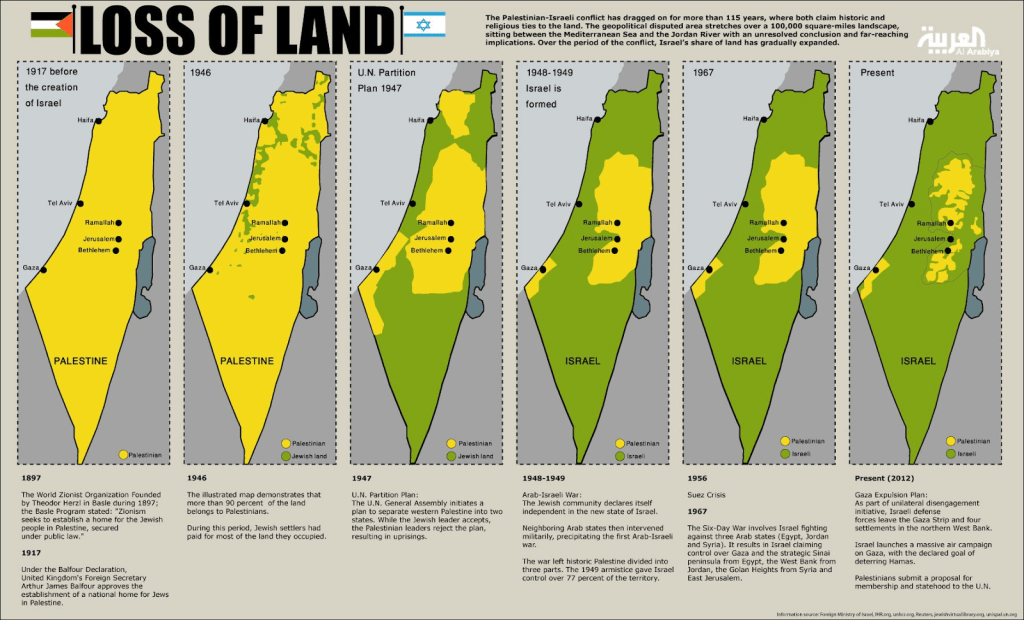
The Nakba wasn’t just an expulsion of Palestinians from their land; it also brought down their economic progress to ground zero. Around 750,000 Palestinians were permanently displaced, which included merchants, farmers, businessmen, and more. They lost their lands, homes, businesses, and properties, the damage being irreparable for an entire generation.
About 90% of agricultural land was lost to Israel, especially the coastal fertile lands. Knowing that agriculture was the primary earning source for Palestinians at that time, the loss is indescribable. The expulsion had resulted in a huge population ending up in refugee camps in the Gaza Strip, the West Bank, Jordan, and other Arab states. This meant being self-sufficient was challenging, and they turned aid-dependent for financial support.
Not to mention the “Israeli Absentee Property Law of 1950”, which allowed the seizure of Palestinian property after the native Palestinians left, were forced to flee, or were deported after the 1948 war. This was extremely beneficial to the Jews and extremely cruel to Palestinians. This was an economic transfer of wealth and assets into the Israeli economy.

The Oslo Accords Trap And Economy Under Israeli Control
After the 1948 Palestine war, the Gaza Strip and the West Bank were controlled by Egypt and Jordan, respectively, and since the 1967 Six-Day War, Israel has occupied the 2 territories. Under the occupation and Israeli apartheid system, the Palestinian economy had hit a major setback.
Palestine has operated within an uneven customs union agreement with Israel since 1967, as a de-facto situation that was institutionalized by the Oslo Accords in 1994, which has accumulated an enormous trade deficit and an overdependence on the Israeli economy. It’s no surprise that being bound in such ways has resulted in slow economic growth, unemployment, and poverty in the Palestinian region.
Now, what exactly is the customs union agreement that Palestine is bound to Israel with? The deal is a result of the Paris Protocol between the two regions. A trade agreement is meant to mutually benefit both states. It was meant to create a shared customs territory between the two, more like a no-border trade, with Israel deciding what goes in and out of the OPT (occupied Palestinian territories). Palestine does not have open gates to the world economy.
Palestine agreed to the customs agreement in high hopes that such arrangements would be temporary, with immense pressure from the West to sign the “peace deal” between the two regions. Then, Palestine was governed by the Palestinian Liberation Organization (PLO), led by Yasser Arafat, who believed that these agreements would transition into the establishment of an independent state. He was unfortunately too optimistic, and the transition never occurred.
Israel imposes import taxes, VAT, and customs duties on goods being transferred to the OPT from Israeli ports. This affects industrial growth, as the goods are often expensive and their prices are unpredictable. If Israel decided to increase taxes substantially? It can do so without minding the consequences on the Palestinian economy.
And what if Palestine wants to trade its goods with its neighboring Arab states, like Jordan and Lebanon? Not possible unless Israel permits. The hurdles created by Israel and its control over Palestinian land make trade of goods from Palestine to the rest of the world costly and even unreachable at times. Tax clearance in Palestine is the largest source of public income. Israel is assigned to collect these revenues and transfer them to the OPT, but often withholds and delays transfers as a means of political pressure or punishment. Palestine is also not permitted to have their own currency. This deal was signed by the two, with Israel accepting thousands of Palestinians to continue working in Israel. Now this looks less like a partnership and more like an attempt to cage the Palestinian economy.
Israel-imposed restrictions on the movement of goods, services, and the citizens of Palestine do more damage than they would seem on the surface. Israeli checkpoints, roadblocks, and customs and transport procedures (including cumbersome and costly procedures at the ports) have imposed prohibitive transaction costs on Palestinian exporters and importers. This weakens the competitiveness of Palestinian goods. For example, a 50-percent reduction in import, export, and domestic transaction costs, i.e., as a return to the pre–Second Intifada levels, would increase GDP by around $2 billion (Eltalla and Hens 2009).
Today, all imports and exports passing through Israeli ports must first go through one of the Commercial Crossings (CCs) operated by Israel and built along the route of the Israeli–West Bank Separation Barrier. For example, worker productivity in the median firm in East Jerusalem, where Palestinian residents face relatively few trade or movement restrictions, is twice that in the West Bank and almost three times that in Gaza, where they face the most severe restrictions (UNCTAD 2016).

So, What Now?
Economies thrive on freedom – freedom of choice, decision-making, and movement. Palestine has been denied all of these freedoms.
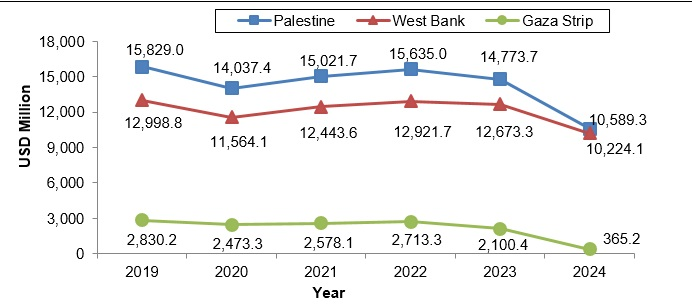
The heinous recent events require no introduction. The war has flattened out the majority of the Gaza Strip to an extent where it will take approximately 70 billion USD to reconstruct, according to recent reports. It has led to unimaginable loss of life, trauma, and ruins in the Strip.
“We can not fight for our rights and our history as well as the future until we are armed with weapons of criticism and dedicated consciousness.”
― Edward W. Said
These fierce lines, spoken by Palestinian-American academic, literary critic, and political activist Edward Wadie Said, are inspiring and reassuring in dark times, as they are today.
Reading this might make the reader feel like a healthy economic and social state is nearly impossible to achieve, but let me assure you that if given the opportunity, they will rise. And they will rise higher than one could comprehend. I am yet to study a community as strong, steadfast, and resilient as the Palestinians.
The land, which once grew beautiful, rich olive groves and boasted its well-established, thriving agricultural sector, currently lives under the rocks of oppression, with its deep roots gasping for breath amidst the occupation. Control over resources, control over movement, and (disguised) control over the economy are colonialism in its modern form. Palestine deserves the freedom to grow, rebuild, and showcase their culture to the world.
This article restored faith in me that there’s absolutely nothing one can’t overcome. The Palestinians are a prime example of the same.