how to win (more) medals: a host’s rulebook 101
Salil Deshpande
FY B.Sc.(DS) 2025-29
Reading time: 10 – 12 mins
The tradition of rewarding athletic excellence began with olive crowns in ancient Greece and evolved into medals—now iconic metallic ornaments worn around the neck. Though the symbols have changed, the drive to win remains timeless.
Now, let’s say you are hosting a multi-sporting event, starting from the most community-based one like the Francophone Games or Pan-Arab Games, to even the most awaited five-ring studded Olympic Games, there are some things that remain unchanged: the cheers, the podiums, and the anthems.
Yet, way beyond these factors, one can’t help but wonder — what really fuels this race for glory? Is it the love of the sport, the pride of the flag, or something more calculated hiding beneath the surface? And when a host nation manages to walk away with the highest number of medals, is it simply the result of hard work and natural talent — or could there be something that works quietly under the table to silently tilt the medal table in their favour?
I won’t make you ponder too much, instead lead you to the old, dusty, time-tested “rulebook”: a collection of controversial and yet efficient tactics that have been used everywhere, from the Olympics to the SEA Games, and have always yielded results that do raise a few eyebrows but work nevertheless.
Hence, welcome to the world of: (drum roll) MEDAL ENGINEERING!
Sometimes also called “home effect”, this term came into routine usage as scholars and commentators began analyzing how host countries manipulate event scheduling, venue placement, and sport inclusion to favor their athletes and eventually win medals. It is somewhat a mix of politics and pageantry, the act behind the act, the sports behind sports.
SO, WHAT IS MEDAL ENGINEERING?
Hosts have often displayed tendencies to “bend the rules” so that they fit the definition of “home luck”.
Home luck in sports refers to the subtle edge teams gain on home turf—beyond crowd support or travel ease. It includes psychological comfort, familiarity, and fortunate breaks.Take India at the Commonwealth Games, for example. Having competed in 18 editions, India’s best ever performance at the Games came when it hosted the event in 2010 in New Delhi.
Before we begin, here’s a bonus: Indonesia, one of the only countries to have contested at every edition of the Asian Games, achieved its best ever medal haul in 1962. Having hosted the event in 1962 and then in 2018, Indonesia managed to finish in the top 5 in both their home editions.
Now, that’s just theoretically speaking. Let’s talk numbers. What if I told you this effect works well enough for hosts even at the biggest global event: the Olympics? Have a look!
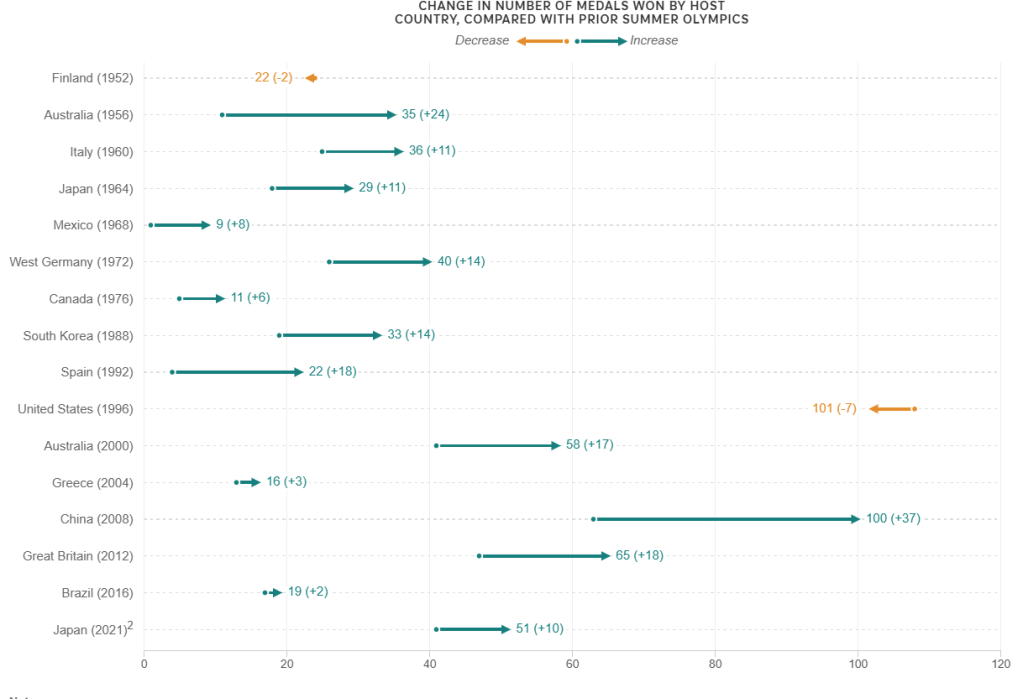
Source: Original analysis from FiveThirtyEight. Medal count in previous Olympics from Olympedia. Japan’s medal count in the 2020 Summer Olympics from Olympics.com.
Credit: Duy Nguyen/NPR
With the exceptions of Finland (1952) and the United States (1996), every other host nation saw a positive change in their medal tallies. Hence, these examples bring us to one concrete understanding: home luck is real and it does exist.
#TRICK 1: THE UNSAID UPPER HAND
As I said, hosts do manage to win more medals when their athletes know what conditions they will be playing in. Hear it from Briana Scurry, former goalkeeper for the US Women’s Football Team, who recalls their gold-medal match from the 1996 Summer Olympic Games in Atlanta, “[We] had 76,000 people at the final in Athens, Georgia, all cheering for us. And China had, literally, a little tiny section of red up high in the nosebleed seats.”
Hosts enjoy a clear advantage: reduced travel fatigue. Visiting athletes often face jet lag, physical strain, and environmental shifts that can impact performance—especially at high-stakes events like the Olympics. While others are busy adjusting to time zones and recovering from long journeys, host athletes gain extra training time and early access to Olympic venues, allowing them to sharpen their edge well in advance.
Say, if you were to host something of a certain high magnitude, you would want your country to win (more) medals. Medals more than what home luck can guarantee, in other words, a sort of “souvenir” for the efforts you put in as a host. Hence, here comes trick 2.
#TRICK 2: WHAT DO YOU MEAN YOU DON’T PLAY THIS SPORT?
As weird as it may sound, trust me, hosts have actually used tricks along these lines to win medals. Hence, our second trick in the rulebook deals with the inclusion of indigenous, lesser known sports in order to win medals.
Our first example comes from Cambodia. In 2023, this country hosted the SEA Games, a subcontinental sporting event exclusively for athletes in Southeast Asia. The controversy began when the hosts decided to include traditional sporting events like Kun Khmer and Ouk Chatrang. Kun Khmer, which is their version of kickboxing, meant 14 out of 19 gold medals in this very event went to Cambodia. Similarly, they swapped out chess for the latter. The outcome? Fewer competitors, more chances of winning medals.
A similar tale had unfolded at the 2019 edition of the SEA Games when the Philippines had hosted the subcontinental event. This edition instead saw the entry of a Filipino stick-fighting game, Arnis, which fetched the hosts 14 gold medals out of the 20 that the event had to offer.
Just one more to go now: Indonesia. This country was able to pull off a similar stunt at a comparatively bigger event when it hosted the 2018 Asian Games in Jakarta and Palembang and introduced Pencak Silat, Indonesia’s variant of martial arts. The hosts then won 14 out of the 16 gold medals entirely in this event and took a commanding position in the medal table.
Cheeky, isn’t it? It’s like inviting your friends over for a potluck but insisting everyone likes your grandmother’s long-lost recipe instead.
#TRICK 3: THE CROWD CHEERED…AGAINST ME
Imagine the entire crowd in the arena booing an umpire or a referee, hurling verbal abuses at them, or even attacking them just because their judgement did not favour the local athlete in a match. This is the daunting reality many judges face when it comes to judging high-intensity matches at a level where stakes are high. This brings us to our third trick in the host’s rulebook: using a passive-aggressive crowd to pressurise judges and influence their decision.
At the 1988 Seoul Olympics, South Korea sought to showcase its transformation into a modern, export-driven nation. This national narrative influenced public sentiment—and possibly officiating. In the men’s lightweight boxing final, local boxer Park Si-Hun was controversially awarded victory over Roy Jones Jr., despite Jones landing more punches. Nearly 30 years later, Si-Hun personally gave Jones the gold medal, acknowledging the disputed outcome.
Let us explore a few more cases where crowd interruptions were so strong that they ended up affecting the flow of the games, shall we?
During the final match of the 1967 Thomas Cup (an international men’s team badminton event) between hosts Indonesia and Malaysia, the local crowd turned extremely hostile towards Malaysian shuttlers, using mirrors to disturb rallies and booing the visitors when they won a point. After winning the final with a scoreline of 6-3, the Malaysians had to flee to the airport under the cover of darkness, speculating on possible public unrest.
Indian cricket crowds have occasionally turned violent, especially after poor performances or during politically charged matches. In the 1996 World Cup semifinal against Sri Lanka, unrest at Eden Gardens led to fires and stone-throwing. A 1999 Test against Pakistan saw similar hostility, with anti-Pakistan slogans and objects hurled at players. While such incidents have declined, crowd behavior remains unpredictable during high-stakes games.
These cases highlight how crowds hold power to influence the routine of games, most often working in favour of home athletes and turning out to be a nightmare for those who stand against their favourites, sometimes not even sparing regulating bodies and higher ranked officials.
#TRICK 4: MY GROUND SO I DECIDE WHO PLAYS
This trick in the rulebook deals with a straightforward advantage countries hold as hosts: direct qualification. That’s right. Imagine qualifying directly into sports you wouldn’t have otherwise qualified in, along with the added advantage of sending in more athletes in individual sports which indirectly gives you more chances of a podium finish.
Our first and by far the most prevalent example comes from the football event from the Rio 2016 Olympic Games, the first time that a South American country hosted this extremely expensive event against the backdrop of multiple concerns and controversies. Brazil, the host, had already won the FIFA World Cup five times, the latest being in 2002. IOC Regulations laid down a set of rules which specified that countries had to first participate in their respective continental U-20 competition, and only those who finished first would qualify for the Summer Games. Brazil, the overwhelming favourites, failed to secure their seat after finishing fourth, behind their equally giant neighbours in football: Argentina, Uruguay, and Colombia. Brazil was looking to qualify through this very tournament as it would help in preparing their U-20 team for future prospects but failed in doing so. The news of their automatic qualification came as a lifeline because it helped them in clinching their first ever Olympic gold in this sport under Neymar Jr. ‘s captaincy.
When China hosted the 2008 Olympics in Beijing, its automatic qualification as hosts meant the host country could send in more athletes in individual events. Hence, this was the first time that China was able to dominate the medal table in gymnastics, a sport it had long wanted to conquer but never really could.
Another significant example of a host nation’s advantage was spotted during the 1995 Rugby World Cup when South Africa hosted this mega event for the first time and managed to lift the trophy before its home crowd too. South Africa had long been the victim of apartheid and this had led to its ban for nearly three decades from international rugby matches. South Africa only managed to enter the circuit in 1992, just three years before it could host the World Cup. Limited international exposure, a handful of test matches before the World Cup and a lack of knowledge regarding the playing styles of other rugby powerhouses, plus the added pressure of playing before their home crowd meant the South Africans had a lot to worry about. However, they managed to pull off something that was truly unforeseen: they became world champions! On the way to the trophy, they defeated defending champions Australia, semifinalists France and favourites New Zealand, and were awarded the trophy by their incumbent President Nelson Mandela who fancied a Springbok jersey during the finals. A few eyebrows were raised later on when several controversies surfaced regarding an alleged poisoning of the All Blacks by a nurse named “Suzie”, a controversial good-to-go signal being given to the semi-finals, and the springboks journey Mandela fashioned.
Let’s rewind to the 2023 SEA Games in Cambodia, where the host not only tweaked the sports lineup but also handpicked who could compete. Badminton, a major event in Southeast Asia, saw the debut of the mixed team category—raising eyebrows. Cambodia then barred regional giants like Indonesia, Malaysia, Thailand, Singapore, Vietnam, and the Philippines from participating. Who played? Cambodia, Myanmar, Brunei, and Laos—none strong enough to pose a real threat. Unsurprisingly, Cambodia took gold, Myanmar silver, and the rest shared bronze. A masterstroke, indeed.
Such examples show how hosts cleverly shape mega events like the Olympics to their advantage—and likely will keep doing so. As long as those in power treat these spectacles as personal medal-laundering galas, shady tactics will slip through. In the end, while athletes write their stories, it’s the backstage planning that decides which ones shine and which stay in the shadows.
Exceptionally well written and engaging — it held my attention from start to finish. Even for someone like me who isn’t particularly inclined towards sports, I found it genuinely fascinating.
Such a good article, loved it!
It was such a good read , the explanation was soo clear , specially loved the rulebook idea !!!
Very good salil
Many more like this from you
All the best🍫
Very well written, engaging from start to finish, especially when the subject is known and yet the depth and breadth of examples was an eye opener.