Remember That You Must Die
Name – Rangana Guha
Batch – 2025-2029
Estimated reading time – 10 minutes
When we think of art, we often imagine the grand works of genius – the dramatic, theatrical works of Carvaggio, the chiseled marble of Michelangelo, the ephemeral light of Monet’s water lilies or the captivating works of DaVinci.
A remarkable thing about art is that it doesn’t exist in a vacuum. Numerous factors, however small or large, influence artists and ultimately influence what we see in museum walls and history books.
Some of the most notable shifts in art have been caused by pandemics. Across centuries, disease and misfortune has left a profound impact on artists and their art.
Danse Macabre from Talllinn by Bernt Notke (c.1500).
In the mid 14th century, Europe was struck by a rodent disease that spread through flea bites. Later referred to as the Black Death, this plague is one of the most well known epidemics that has struck humanity at various intervals of history. The most lethal strain of the plague hit Europe in the 14th century, in an outbreak that resulted in the loss of millions of lives. It is estimated that the continent’s population declined by 45-60% at the time. The pandemic is said to have arrived in Crimea by the Mongols and had been transported to Europe by sea through merchants. Cities and towns emptied and villages vanished, and the artists of the time responded in a fashion that was of sheer egalitarian horror – giving the macabre its footing in artwork. Death was portrayed not as a heavenly passage to transcendence, but as a terrible, intimate presence. The clearest example of this is the Danse Macabre, or the Dance of Death. These were allegorical images that were engraved, painted or depicted in murals that portrayed skeletons leading people from all walks of life and social classes into a grim dance toward death. Kings, priests, merchants and peasants alike were part of the same procession, as death was the great equaliser. It is important to view the Danse Macabre as more than a creepy, obscure art form, and as a form of radical social critique. It was the first time art mocked the hierarchy of the elite so definitively and effectively. In a period of plague, the crown offered no more protection than a pitchfork. This was an early onset of a new, grim realism that’d eventually evolve into the Renaissance.
As the initial shock of the 14th century subsided, the obsession with mortality however, did not fade. It instead became more literary and visceral. By the 15th century, a new and unsettling funerary fashion emerged within the European elite: the “Transi” or Cadaver Tomb. Now before the Black Death, a noble’s tomb generally featured a gisant, which is an effigy of the deceased lying in a peaceful, prayerful repose, looking as they did in life. The Black Death had however stripped the sense of “dignity” or the impression of permanence of a body. In response, the wealthy started to commission a Transi or a double-layered tomb where the top layer would show the person as they were in life – clothed in robes of office, while the bottom layer would reveal a “transi” (or transition), depicting a sculpture of the body in a state of morbid, hyperrealistic decomposition. These graves were designed as visual Memento Mori (“Remember you Must Die”), to emphasise on the impermanent, ephemeral nature of life. They depicted corpses with shriveled skin, exposed ribcages, and sometimes even “vermin” like worms and maggots gnawing through the sickly remains.
The deceased was represented as passing through a liminal period of decay and this meant their soul was going through purgatorial torment. The beholder was invited by the image to aid the dead individual, as it was believed that their prayers could accelerate the process. The depictions of vermin were made with the intention to convince the viewer that their prayers had indeed succeeded and were banishing the vermin out of the corpse. Cadaver effigies stressed the humility of the dead, and the exposed state of the cadaver was intended as an expression of humility and humbleness.
In the 16th century, the plague’s influence had migrated from the stone tomb in the cemetery to the private study. The literalism of the Transi tomb softened into a more intellectual symbolism. This era saw a rise in the usage of the skull in European portraiture and domestic life. The skull shifted from a morbid remnant of the pandemic to a “prop” or tool for Neo-Stoicism, which was a movement in the late Renaissance period aimed to revive ancient stoicism in a form that’d complement Christian values. The philosophical roots of this shift lie in the roots of Roman stoic thought, led by thinkers like Justus Lipsius. In a world where plague outbreaks were unpredictable, recurring threats, neo-stoicism offered a way to confront or endure through Premeditatio Malorum or the Premeditation of Evils. In his Meditations, Marcus Aurelius wrote “You could leave life right now. Let that determine what you do and say and think.” By keeping a skull on one’s desk or an image of an hourglass with the sand running, one confronted the image of their end daily, so the actual arrival of a pestilence could not cause spiritual or psychological panic.
This philosophical discipline reached its aesthetic peak in the 17th century Dutch Republic and Spanish courts through the Vanitas still life. The term itself is derived from the Latin book of Ecclesiastes: Vanitas Vanitum, omnia vanitas (“Vanity of Vanities, all is Vanity.”) In the Book of Ecclesiastes, vanity is frowned upon because it deals with impermanent things that avert our attention from the only certainty, that is death. The saying “vanity of vanities” is to emphasise the futility of all earthly things when confronted with the certainty of death.
While the 17th century was a time of great mercantile wealth and frequent military conflict, the Vanitas were rife with objects and motifs intended to symbolise the transience of life, the ephemeral nature of worldly treasures, and the pointless quest for power and glory.
In these compositions, the tension between the Dutch mercantile success and Calvinist philosophy of the population met in a calculated stalemate. At the time, the Dutch Republic was among the wealthiest nations on Earth with riches flowing in from every corner of the world. However, this material accumulation created an interesting dichotomy, since the Dutch were by and large devout Calvinists who believed that worldly excess was a distraction from spiritual salvation. A Vanitas painting hence also posed an interesting dichotomy, as the artist painted tainted objects of luxury and the richer classes spent their riches purchasing these artworks that critiqued the futility of their wealth, whilst performing penance.
In order to decode the Vanitas, it is important to understand that every object on the canvas is placed deliberately and carries a philosophical argument with itself.
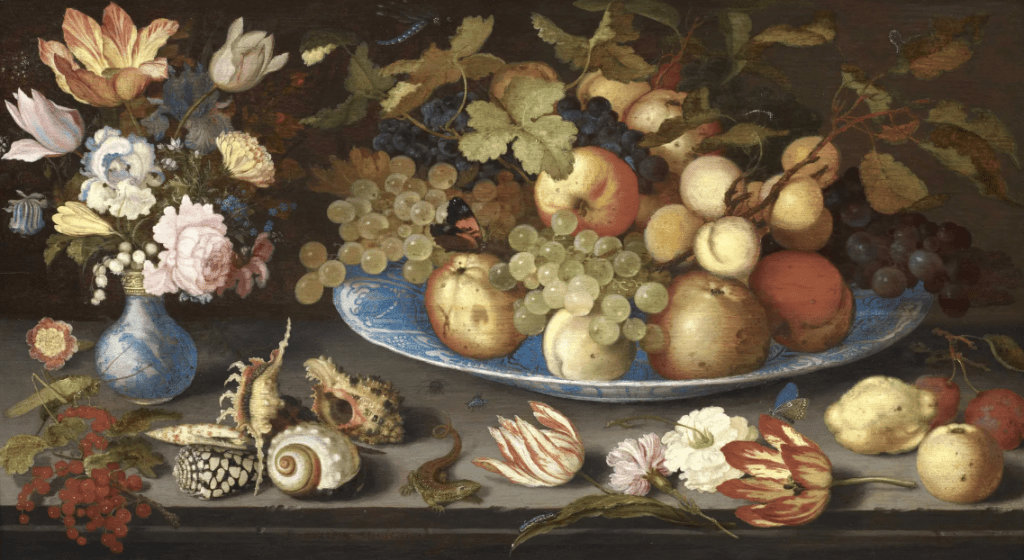
In this still life featuring flowers and fruit by Balthasar Van Der Ast, for example, there’s a number of intriguing motifs and references that are worth looking into. In the vessel containing the fruit, only the grapes (which often symbolised Christ) are still fresh, while the other fruits are blighted by moths and worms. Some of the flowers have wilted and fallen off the stem, in reference to their mortality and by extension, our very own. The presence of flies and lizards, which could both represent evil, hint at the physical and moral decay that’ll occur if one fails to follow a righteous path.
The fruits are placed in a Wan Li bowl, which is made of luxurious Chinese porcelain, a nod to the country’s trade with China at the time. There also sit nautilus shells which are actually only found in the Indo-Pacific region, and made it to the Netherlands via trade, as it was the center of global maritime trade at the time. The inclusion of such global “spoils” – the porcelain and the Nautilus shells – serves a dual purpose. They act as a subtle boast of the Dutch’s maritime reach on one hand, and on the other, they serve as a reminder that the vast reach of the empire is merely a hollow husk when faced with biological reality.
Other recurring motifs in the genre served as similar reminders- an extinguished candle with a smoking wick was a symbol representing the death of an individual and the swift, inescapable passage of time, violins could remind the viewer of the threads of time and that all beautiful things can come to an end while ones with snapped or missing strings could signify contention. In these frames, the skull ceased to be just a terrifying skeleton in a public mural; it was a private luxury or an ode to the western eye that could no longer see beauty without acknowledging the rot beneath it.
A remarkable thing about art is that its presence, influence, and wisdom remains long after a pestilence has subdued. From the morbid horror of the Danse Macabre to the opulent warnings of the Vanitas, the legacy of the Black Death proves that art does not exist in a vacuum. The profound shifts triggered by the 14th century plague changed the way we perceive the world. Today, we look at these works not to merely study the medical history of the past, but to seek how our ancestors found courage when they felt like the world was ending. The museum walls and history books remind us that even when our physical bodies are at their most fragile state, our ability to transmute grief into meaning is our most enduring strength.
Very informative! Well done!