
Survival of the Flexible
Name – Ananya Warrier
SY BSc (2024-28)
Estimated Reading Time: 6 minutes
Recently, the American public witnessed the third-highest total number of people dying as a direct result of guns annually in the last fifty years, with a total of 46,728 people, as of 2023. This includes people who died by mass shootings, suicides, and homicides. Naturally, many people have started rallying around altering, or even removing, the Second Amendment – which states, “A well regulated Militia, being necessary to the security of a free State, the right of the people to keep and bear Arms, shall not be infringed.”
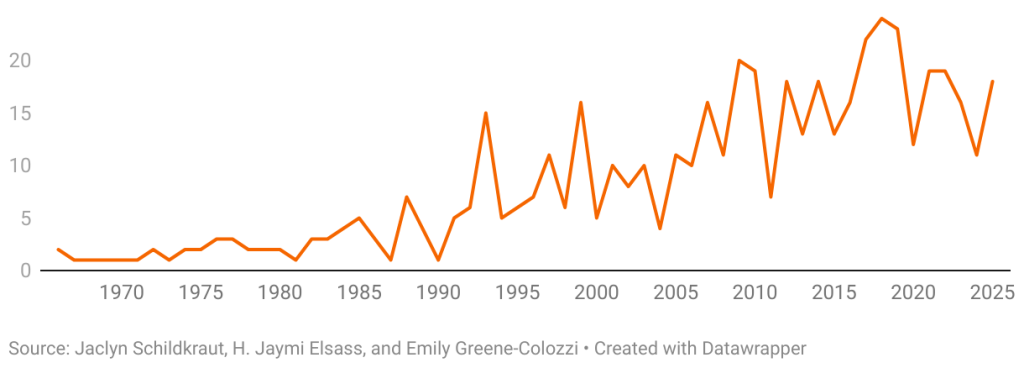
Number of mass shootings in the United States
This Amendment was put in place in 1791, after the American Revolution. One of the most prominent arguments among the Constitution’s framers was that oppressive regimes would use soldiers from their large armies to easily oppress their people. The Union was weak, and states were not entirely sure how long it would last, or if the federal government or other states were truly their allies beyond the temporary moment of gaining independence from the British. They worried that in case of invasion by another state or government, the federal government could potentially ban firearms nationwide as a workaround to make states unable to muster a defense force.
To counter this hypothetical threat, some asserted that the best deterrent would be to have each state raise its own militias. These militias would be composed of average citizens who would be granted the right to gather and possess their own armaments, while also receiving part-time military instruction and pay from their state governments.
However, this paper was written over 250 years ago, and the world has since changed considerably. While most soldiers from 1791 used muskets, we now have automatics, rifles, revolvers, and a plethora of other weapons. The United States is also not under threat of dissolution, and so there really does not seem to be a need for this Amendment. Yet, the few attempts that have been undertaken to repeal the Amendment have proved challenging – mainly due to the process it involves. This includes the amendment being proposed by two-thirds of the House and Senate, then being ratified by three-fourths of the fifty states, i.e. thirty-eight states, regardless of which political spectrum one may belong to. In fact, the last amendment that was put in place was in 1992, which prevented Congress from changing its own compensation during a term in progress.
Why is it so difficult to amend the Constitution of the United States?
In the process mentioned above, an overwhelming majority is required to even propose an amendment, let alone repeal an amendment. However, the current dynamics of constitutional politics have thwarted coordination between the national and state governments and between the two national political parties. The only amendment that has been repealed is the 21st Amendment, which instated Prohibition (which banned the manufacture, transportation, and sale of alcoholic beverages from 1920 to 1933 to remove the “ills” of society), and was, of course, not at all popular (alcohol was needed to cope with the Depression of 1929).
This means practically all proposals are “dead on arrival,” and the Constitution remains frozen in time. In fact, the American Constitution continually tops the global charts on constitutional rigidity. Nearly 12,000 proposals have been initiated, but a meagre 27 have been accepted – an acceptance rate of 0.002%. Compare this to India, with about 106 amendments since independence in 1947. The Indian Constitution was drafted to be as comprehensive as possible, with legislation for a wide range of issues. However, once they were tested in real life, they needed to be amended, so many amendments were made, especially in the early decades. Along with this, there were several changes in the social and political spheres, such as integrating the princely states, drawing up state lines, land reforms, establishing a democracy, etc. For this reason, amending the Constitution was relatively easy, needing only two-thirds of the members present and voting, in both Houses.
Why is it so necessary to have a Constitution that is (relatively) easy to amend?
If a Constitution were rigid in nature, governments would not be able to act and react to changes that occur in society. Laws must be able to change with the changing needs of society. Take the digital age, for example. India has put in place a Digital Personal Data Protection Act, 2023, and China has a Personal Information Protection Law, 2021, but the United States has no such national law in place, although regional laws do exist. This is because the USA follows a federalist system. While this system was first put in place to create a strong national government without stepping on the toes of state governments, it has now become more of an obstacle for the national government to address national problems than a provision for the autonomy of states. One such example of this is abortion rights. The Supreme Court’s Roe v. Wade decision made abortion a constitutional right that was binding on all states. Ever since the Supreme Court overturned this decision, all 50 states have various stances on abortion, as seen in the following image.

Having said that, there are dangers to having too flexible a constitution – many governments have collapsed, or have misused the constitution to shift power to the executive branch. Take, for example, the new Hungarian constitution, enforced on January 1st, 2012, was drafted by the ruling party Fidesz, which had won about two-thirds of the seats in Parliament. This gave them the opportunity to remove the pre-existing constitution and establish a new constitution practically unopposed by the opposition, media, and civil society.
In a similar vein, when the Russian Federation was born in 1993, it changed from a soviet system to a semi-presidential democratic republic, with strong presidential powers retained for then-President Yeltsin. After the amendments of 2008 and 2020, there has been a restructuring of government, making it more centralised, with greater powers being vested in the President.
In Pakistan, former President Pervez Musharaff’s quest for absolute power resulted in many changes to the 1973 Constitution. However, when he fled Pakistan in 2008, a 27-member committee ended up rewriting about 1/3rd of the constitution. All this goes to show how the constitution was nothing more than a political tool, repeatedly adapted to suit whoever was in power.
So, what is the solution?
A balance of rigidity and flexibility is the optimal solution, much like the Indian, Canadian, and Australian constitutions. In the case of the Indian constitution, the makers resolved to draft the constitution to change alongside the changing needs of the country, while maintaining the fundamental structure of the constitution, thus maintaining a balance of power. Hence, the method outlined in the Constitution to amend laws is neither too simple nor too complex. We also have ‘constructive ambiguity’, wherein some laws may be interpreted in different ways, depending on the case at hand. The Canadian constitution was built on the idea of allowing citizens to challenge laws that compromise on their rights, while the Australian constitution also follows constructive ambiguity, with the judiciary interpreting their constitution in a modern way to meet modern needs.
In a way, measuring whether a constitution is flexible or rigid also helps us understand the degree of accumulation of power in the country, whether it leans more towards being democratic or autocratic. In the case of Hungary, only a select few politicians from one party were on the drafting committee. There was no discussion with the opposition party or the public, and many critics have deemed the constitution undemocratic.
Thus, with regard to constitutional amendments, striking a balance between rigidity and flexibility is a must. This allows for addressing the complexities of a dynamic society while ensuring that the foundational principles are protected. While the American Constitution has stood the test of time, as was intended by the Founding Fathers, it also remains stuck in the same time period, with very few amendments to reflect the change in society. This could widen the chasm between constitutional rights and current requirements of society. A more flexible constitution would actually strengthen its authority, allowing it to evolve with its people.