
Art Forgery: The Classiest Crime to Exist
Tanaya Ghosh
FY BSc Economics (2025-29)
Estimated reading time: 5 minutes
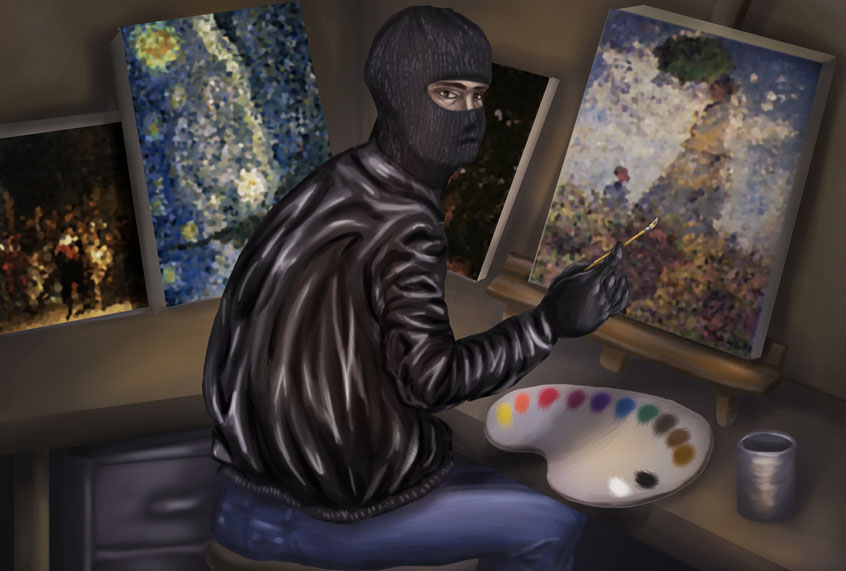
It has been estimated that nearly 20% of all works of art to ever exist, be it in museums or art collections, are fake. Art forgery is a shadowed tradition that has persisted in society for centuries. A forgery is defined as “a work of art whose history of production is misrepresented by someone to an audience (possibly to a potential buyer of the work), normally for financial gain”. To sell the finished product as having been made by a well-known artist, a forging artist will paint or sculpt a piece in the style of that artist. Since they will be hard to sell to informed buyers, exact replicas of already published works are rarely faked. It is a curious craft, whose practitioners are often heavily debated over. If one were to judge a work of art based only on its aesthetics, then a forged piece of art should by no means be any less worthy than the real piece. But if one takes into consideration authenticity, creativity, work ethics and the history behind a painting, forged pieces of art seem to be nothing more than a cheap imitation. Many forgers enter into this trade out of desperation. Art is an extremely difficult means to earn an honest livable wage from, so many artists instead channel their talents into this line of trade just to survive. Of course, conversely there are also forgers who do it simply for the love of the game.
A successful art forger must be a historian, a chemist, and an artist—all concealed within a criminal. To make a fake look real even under intense scrutiny, one must go through extreme means to achieve the effect. Recreating old works is not just about mastering the craft but also about knowing exactly what types of paints to use, what to do to achieve the look of a painting aged for decades in just a few weeks. The canvas used must be old and convincing enough to fool even the best experts. They even have to scatter dirt over the painting, just enough to make it look aged.
All this effort is made because modern technology has come up with incredibly precise methods with which one can distinguish a fake artwork from the real. They artists themselves rarely ever sell the fakes. They have contracts with other people who go and act as the source of the art; these sellers need a very convincing backstory as to why they even have such high value artworks at their disposal. Without sufficient certificates to back a painting’s authenticity they are usually sent to experts to analyze. These experts use various techniques to find the fake. For example, they use ultraviolet light to see if the canvas has any sketches or paintings beneath the visible drawings, as this would suggest that someone has reused an old canvas to make this piece. X-rays are also used to determine what elements are present in the pigments used in the paintings. This is often a great method to catch forgers as it is very hard for them to find the exact types of paint used by artists over decades ago. Such advanced methods have made it incredibly hard for artists to forge paintings in the current times, though of course it isn’t entirely impossible.
Yet, despite knowing all the hard work and skills that it takes to be a successful forger, can we truly give them the title of an artist? Some people online argue that an art forger can never be an artist. They may be called craftsmen, for their mastery over the craft and its methods is undeniable; but to be an artist one must also connect emotionally to their pieces. What they have is skill, not art. An artist must have it in themselves to imagine and create a unique piece of work that can show people how the world looks through their eyes. Mastery over technical skills is something that even a highly trained robot can achieve. But creating unique artworks that arouse emotions within the hearts of the viewers is a special skill that only a few chosen humans can acquire. When a forger creates a work of art, their primary intent has always been to deceive the viewer. There is no underlying emotion and meaning behind their craft that adds value to their art. The aesthetic experience of viewing an artwork is not detached, but relies on contextual knowledge to elicit the proper emotional response. The viewer, who once perceived profound emotional depth, now recognizes only a clever mechanism of deceit. This knowledge destroys the work’s aesthetic integrity, transforming it from a priceless cultural artifact into a documented proof of crime. Once the charade is over, people see the lack of sincerity in the work and fail to find any human connections in it, ultimately labelling the art as worthless.
Imitations not only defile the historical context of the original piece, but also falsify our understanding of the past. In the words of Denis Dutton, a philosopher of art, “all genuine works of art can be viewed as creative performances, which represent the ways in which artists solve problems, overcome obstacles, and make do with available materials”.
Art collection is a hobby primarily belonging to people from the upper classes of society. To them, skill is only a small part of what decides the value of art. No one dislikes cool artwork with an even cooler backstory, but the wealthy also like scarcity. Infamous artists who are household names centuries after their passing have only created a small, finite number of paintings. To know that they possess a work of art of which there is only one in the world is a source of pride to the rich.
In the 1890s, the economist Thorstein Veblen coined the term “conspicuous consumption” in his book “The Theory of the Leisure Class.” For most goods, demand falls as the price rises. But for a special category of luxury items, which he called “Veblen goods,” the high price is part of the appeal. These items are mostly used as status symbols. If everyone could buy a Mona Lisa, it would be worthless as a status symbol. Its absolute uniqueness is what allows the market to attach such an astronomical price. Owning it isn’t just pride; it’s a public declaration of economic dominance. Even in the world of the wealthy, be it a millionaire or a billionaire, both have the capability to buy a yacht or a supercar. But a one-of-a-kind painting is unlike most luxury goods. The pride of owning one comes from the fact that its history and story have now become theirs, and that they alone now possess this rare good. It acts as a separator and puts the owners in a class above merely being wealthy.
Now, to every argument there will always be a counterargument; because after all is said and done, many people will still argue that whether their art comes out of their own imaginative realm or someone else’s, art forgers deserve to be given the title of artists. Take the example of Wolfgang Beltrachhi. He is known to have pulled off one of the most impressive feats of art forgery in modern history. He even served time in jail in Germany for his crimes, along with his wife and other co-conspirators. But now it has been several years since he has been out. Wolfgang has gained substantial media fame due to his colorful past and has made full use of it to gain an audience for himself. He now creates works of his own, signed with his own real name and has found decent amounts of success in doing so. One might even say that due to his history, these paintings now have a richer backstory, making them even more valuable. His story shows that it isn’t as if all forgers lack the creativity to produce their own unique pieces. As mentioned earlier, most choose this path as it has immense financial benefits, albeit illegal, compared to living as an honest artist. For most of them, art is the only thing that they know, and that they are good at. Society is cruel to young artists and so they turn to this path in hopes of an easier life.
It takes immense levels of talent and patience to mimic old works of art that will no doubt undergo rigorous inspections before being sold. From tiny brushstrokes to streaks of dirt to even the chemical components in the paints. They must ‘get into the head” of the original painter and think like them to even begin drawing a successful fake. Forgers have a lot to do in very little time to earn the money that drew them into this trade. In fact, most art forgers are not even successful. Very few people ever sell their art for millions of dollars as modern technology has made it possible to inspect every minute detail of a painting to determine its origins.
Of course, there are some forgers who don’t do it for the money, but rather to make a statement. They forge art as a way to lay bare the greed and snobbery of the art world. They rebel and state that the art world doesn’t in fact care about the quality of art. They care more about the labels of the art, the scarcity of it, and the ability of the art to sell. These people argue that the world of art is mostly superficial; people chase after rarer and rarer works without ever truly appreciating the effort that goes into a piece.
One of my personal favourite examples is that of Tom Keating. He was a socialist, British art restorer who was thoroughly disgusted by the corrupt gallery system. He claims to have faked over 2,000 paintings by more than 100 artists, not for wealth, but to “expose” the experts and dealers as greedy and ignorant. He famously left clues in his paintings, like using 20th-century materials, writing in lead under the paint which could be found using X-Rays, or using a pigment that wouldn’t be invented for 100 years. He wanted to be found out eventually to prove his point. Another brilliant example is Mark Landis. He was an extremely prolific figure in the US who had donated his works to museums for over 30 years without being caught. He never took a single dollar for his works. His motivation was the thrill of deception, the desire for the status and respect that came with being seen as a “philanthropist.” He would often dress up as a Jesuit priest to donate the works, enjoying the performance and the praise from curators.
Ultimately, the case of art forgers presents us with a profound paradox. While they possess the preeminent skills necessary to be called masters in their own right, this formidable talent is rarely ever used to make a statement or to have a profound impact on society. It is used mostly to deceive and defraud others of their money and trust. Yet one can argue that the true genius of a forger lies not in the realm of the conventional rules of art. They are polymaths of deception, with skillsets far more diverse than that of a conventional artist. And so they create an antimony in the world of art; is a stamp of authenticity all that a painting is truly worth? Their works compel us to grapple with the dilemma and face the uncomfortable truth: do actual levels of skill really hold little to no relevance in the modern world of art when compared to a painter’s puzzling provenance?