
SOUTENEURS OF THE PENTAGON
Rudraneel Sinha
FY BSc Economics
Estimated Reading time: 7-8 minutes

Woaaah, hold up. You guys thought I was done explaining the shenanigans of the LGBT community. Hell naahh dawgs, this is not a topic that can be described in one article. You see, explaining the economics of the Military-Industrial Complex is a sophisticated and vast undertaking. The MIC wields massive political muscle, consistently using it to ruthlessly advance its own goals. The MIC precisely follows the ideas of the Italian philosopher Niccolo Machiavelli. The MIC, in its power, uses pragmatism, deception, and even cruelty to maintain power and to ensure its own stability. This topic is very vast because the MIC has essentially colonized the broader economy, making it ‘dual use’. It is no longer about fiscal policy, but about the story of industrial organization, where Silicon Valley venture capitalists and Big Tech firms are as central to national security as traditional defense primes like Lockheed Martin.
I am neither a war hawk nor a pacifist, but I do believe every country deserves reliable suppliers for its defense needs. It’s just that trouble only truly begins to brew when suppliers and buyers grow too intertwined. Since the beginning of the Cold War, the political discourse in the US has been deftly manipulated. Spreading the fear of war across various decades through propaganda further strengthened the need for increased military spending, and, through an unholy nexus with their political establishment, they manufactured consent among the American public for global military superiority.

America’s joint decision with its allies to launch the Global War on Terror (GWOT), following 9/11, only further spurred public spending that was already ballooning to over $8 trillion (not to mention the growing death toll, with 900,000 recorded deaths). My hate for them must seem justified now. You would assume that this must have gotten them somewhere, achieved something, right? No! This didn’t achieve anything. The $8 trillion dollars overwhelmingly benefited corporate America, with the member companies of the ‘merchants of death’ group posting record profits on trillions in contracts. Let’s take a moment to consider the implications of the $8 trillion expenditure. This significant amount could have been redirected to support America’s fundamental sectors. By reallocating these funds, we could greatly assist many American citizens facing daily challenges. In the following section, we will explore how this money could have made a meaningful difference in their lives.
Opportunity Costs and the Guns vs. Butter Model
The US spends approximately $900 billion on its defense sector, which is itself a huge amount, as it accounts for the entire defense budget of certain countries. Isn’t that crazy? Now, what if this money were diverted to other issues, such as funding universal healthcare, completely rebuilding crumbling infrastructure, providing free college for every student, and tackling climate change aggressively? In my opinion, the US would have become a utopia if it did, but a fundamental issue here again is the loyalty of these senators in Washington who constantly listen to their masters. Researchers from Brown University’s Costs of War Project further provide how the US has spent about $14 trillion in the 20 years since the US invasion of Afghanistan in 2001, and half of that $14 trillion has gone to defense contractors. If you haven’t got over that figure, then you would also not get over the fact that this money could have been used in a much more productive way, instead of carpet bombing the hell out of innocent civilians in Afghanistan.
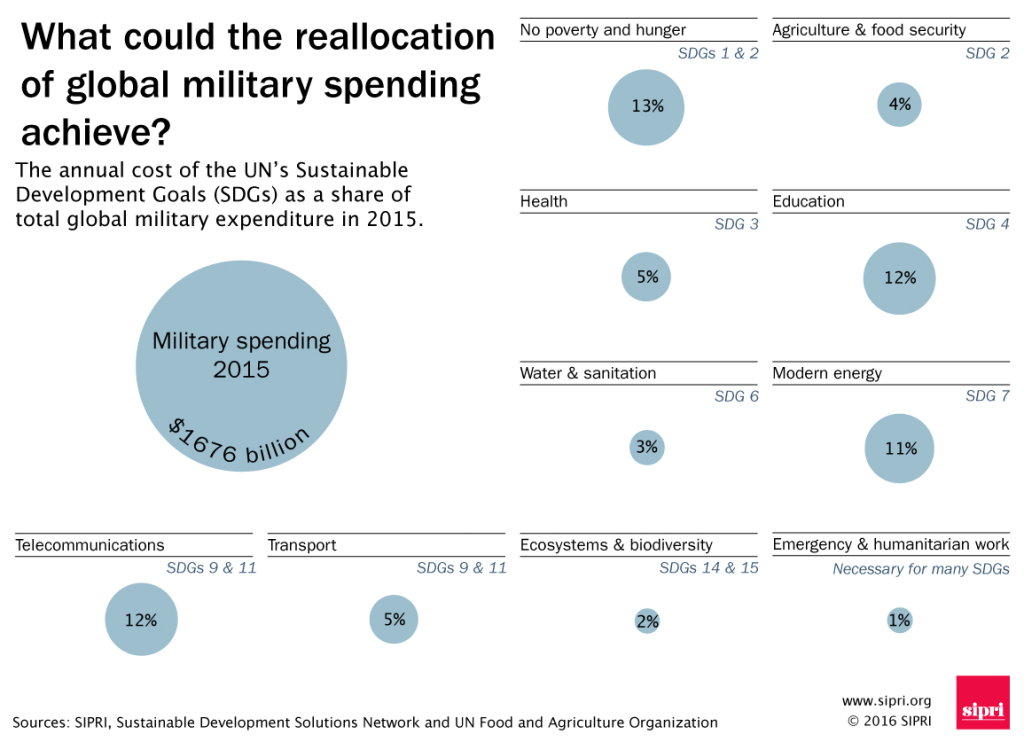
There is also another argument on this, where people say that this was ultimately good for American economic growth, but research shows otherwise. A 1% increase in military spending often slows down long-term economic growth by 1.10%, a fact that seemed increasingly evident in light of America’s economic slowdown in the years following 2001.
This is exactly what happens when military Keynesianism replaces productive investment. The multiplier effect creates jobs, but at the cost of productive growth. A dollar spent on producing weapons might have a lower multiplier effect, but if a dollar is spent on education (or let’s say medicare) – the multiplier impact would be even higher, with enormous long-term benefits in human capital and productivity. The military-industrial complex chose a way to spend money that wasn’t the most efficient for the economy, but was much easier to sell to the public.
Why, you may ask? Because you can immediately see the new jobs being created, which looks absolutely great on paper, but the good things we miss out on (opportunity costs) by spending the money this way are invisible and just theoretical arguments.
The Guns vs Butter model has clearly revealed the economic trade-off of the US, where it has chosen guns over welfare, and this isn’t just any accident – it is an inevitable outcome of a market structure that created political capture, flawed incentives, and political pressure through local economic dependency. The system is designed to make funding the military’s spending habits easier than channeling money to meet civilian needs. And that design is reinforced by rent-seeking behavior, which ensures no one has an incentive to change the system.
Rent-Seeking: The Economics of Influence
Rent seeking essentially means pursuing profits through political influence rather than innovating new products or doing any productive activity. This concept is very well tied in with the MIC because it literally embodies it in the purest form. Influencing senators through lobbying has been a decades-old practice that has been performed by the top defense contractors. These defense contractors keep spending hundreds of millions of dollars annually lobbying the government to ensure that the contracts keep growing, which directly helps them to maintain their market dominance. The money that these firms spend doesn’t develop cutting-edge weaponry but instead buys high-end political influence.
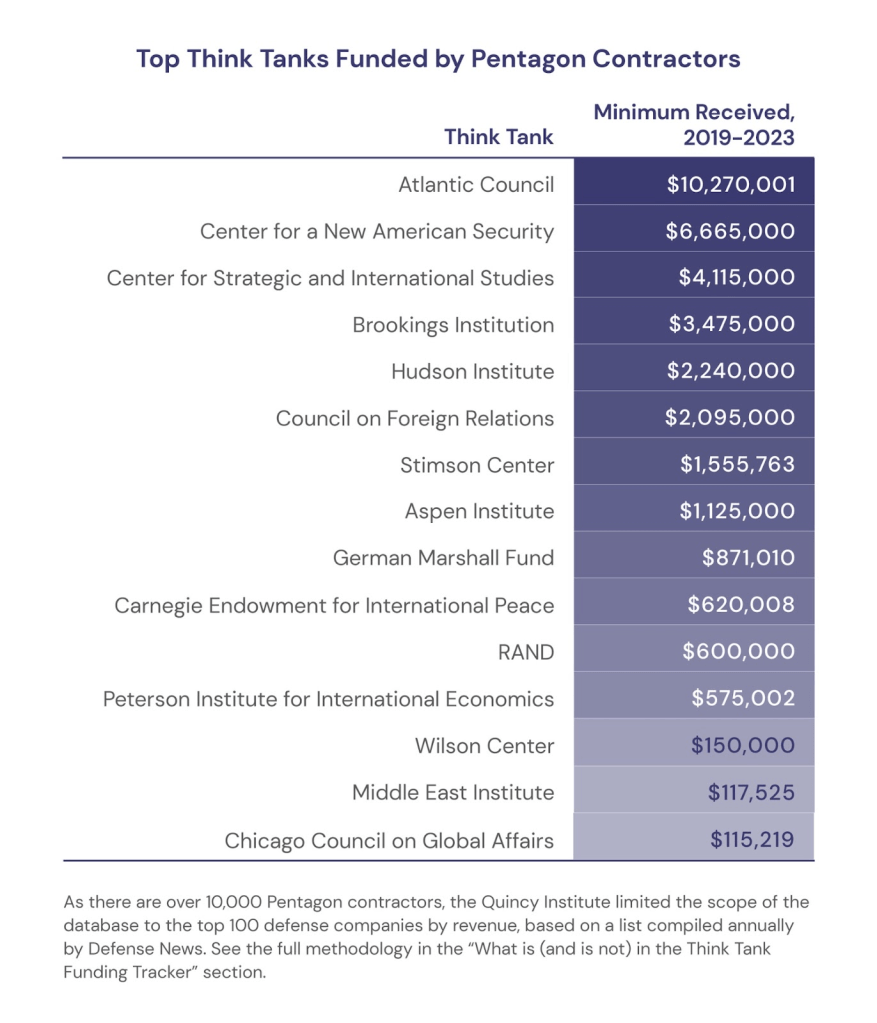
The MIC has a long history of funding think-tanks because these are the leading institutions that shape policy and play a vital role in the American government’s decision-making process. These think-tanks then play an extremely crucial role in engineering chaos, which helps create demand for their master’s weapons, and this is why MIC keeps throwing money at these think-tanks. Far from conspiracy, the Quincy Institute’s 2024 report reveals defense contractors funneled $34.7 million to top U.S think tanks from 2019-2023. The Atlantic Council ($10.2M), Center for a New American Security ($6.6M), and Center for Strategic and International Studies ($4.1M) were top recipients-hard evidence of deep MIC ties. The RAND Corporation is one of the most interesting case studies where rent-seeking works through intellectual capture. It was established by the United States Army Aviation Corps after WW2 and has greatly shaped the military industrial policy for its masters for decades. Their claims of conducting objective and independent research might as well fall on deaf ears, for their fundamental alignment with the MIC’s core ideologies could not be clearer. The above is just one of the case studies, but there are plenty of these out there shaping policy and engineering chaos. Defense firms have understood the one important thing, and it’s that there is more profit in lobbying congressmen than in innovating or improving new weaponry. After all, this is the exact reason why defense projects run decades over schedule, billions over budget, and the majority of the time fail to achieve their objectives. This is also because there is literally no economic incentive to succeed.
Economics of Foreign Arms Sales: Arms for Influence
The MIC didn’t just stick to their own country for selling weapons they have over the years mastered the art of globalizing this rent-seeking model. According to SIPRI’s Arms Transfers Programme, the US is the world’s leading weapons exporter, and for these entities, foreign military sales have become a crucial revenue stream for defense contractors. For instance, the Patriot Missile System, which was sold to Germany in 2024, alone generated $5 billion. Imagine, if a single deal was able to cash in this much money now, just contemplate how many such deals happen daily that are able to pull in billions in revenue. Some European countries paid somewhere around $170 billion to US defense contractors between 2023 and 2024. Such deals along with many other cases showcase how the US uses its geopolitical and diplomatic muscle to pressure allies to buy its weapons even though the entire continent is not at risk of any future catastrophe.

This arms export system simply globalizes the MIC’s domestic flaws – lobbying dominance and cost overruns – locking allied nations into the same perpetuating cycle. Just as domestic military spending creates a dependency through local labor economics, foreign arms sales also create a similar type of dependency through geopolitical leverage, because when a US ally in Europe or in Asia buys weapons from them, these countries are officially locking in for decades. They cannot get spares or repairs, or any upgrades, from any other country except America. Apart from that, these allies are then somehow politically aligned with the US, and this further ensures continued weapons purchases and creates a rationale for further military expansion.
Honestly, it’s a brutal cycle. Instead of genuinely competing, the MIC uses political muscle and military aid from its friends in high places to push allies into buying American. It is, in fact, rent-seeking at a global scale. The worst part is that every single sale just escalates tensions, fueling a never-ending and ever-growing global thirst for more weapons. What these entities have done is turn international relations into a guaranteed sales pitch to create artificial demand for their products and to inflate fear through well-engineered stories.
The dark truth is that the military-industrial complex has become too big to fail, and if it does, it might take Uncle Sam’s entire economy down the drain and possibly the world. This isn’t just any other organization that can be brought down that easily. Bring it down, and you might possibly bring down the entire world economy, as almost all roads lead to the military-industrial complex.
Today, they are indirectly bombing children in Gaza, giving F-16s and Tomahawks to prolong the conflict in Ukraine, and gearing up to annihilate entire generations in Venezuela. Tomorrow, it might just be another country that’s looking out for itself. We must make sure power isn’t unchecked by any party or institution, because when it is, we might essentially be cooked.
As Martin Luther King Jr once said:
“Millions of citizens are deeply disturbed that the military-industrial complex too often shapes national policy, but they do not want to be considered unpatriotic.”
You see, the rot runs deep within people. When a society itself supports a system that wants others to suffer and wants their own money to build weapons of mass destruction, that ain’t no society, that is in fact a soulless bunch of people who mask themselves to hide from the truth that hurts. Until we meet again……..