India Is Not A Dharamshala; Or Is It?
Salil Deshpande
FY B.Sc. (Data Science) 2025-29
Estimated Reading time: 6 minutes
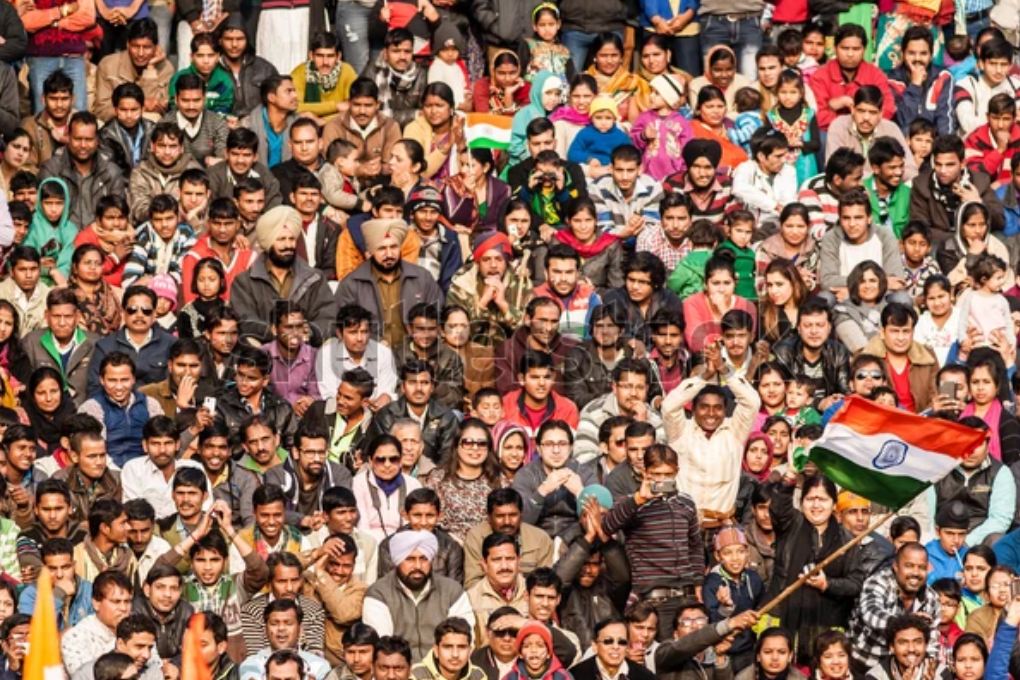
Indian crowd at the Attari border Beating The Retreat ceremony which sees a large gathering every single day
“India is not a dharamshala,” observed India’s top court in New Delhi on a sunlit morning, May 19, 2025. Passed by the two-judge bench of the Supreme Court, this statement came in response to a Sri Lankan’s request for refuge in India who had alleged ties with the LTTE, a banned terrorist group in Sri Lanka.
Now, it isn’t the case that drew much attention nationally, but the statement specifically. It reignited the discussion on the growing problem of refugees in India and the status they hold in a country that abstained from signing the 1951 United Nations Convention on Refugees. It drew a line between India’s cultural beliefs as a host that has preached Atithi Devo Bhava (Guest Is God) for aeons and the increase in internal tensions it now experiences as a nation continuously affected by the influx of undocumented communities into its territory.
But where did this story begin? Who were the first refugees India ever received, and what status did they hold in this developing country? How has the timeline of refugees in India changed over time, and what does the future hold for those who enter her borders today?
Hence, that brings us to the very essence of this article: how the refugee story in India has unfolded over time, how these communities have rooted themselves in a land of many identities, and where their journey may lead next.
PARSIS: THE FIRST RECORDED REFUGEES
In the 7th century, Persia fell to the Rashidun Caliphate after the Battle of Nahavand (639 CE), ending Zoroastrian rule and triggering persecution and heavy taxation of its followers. Seeking refuge, a group of Zoroastrians lit the eternal flame of the Iranshah Atash Behram and sailed to India, settling in Sanjan under the protection of local ruler Jadi Rana.
This community, later called Parsis (“Persians”), numbered around 18,000 and preserved their faith while adapting to their new homeland. Under the British Raj, they became known for surnames ending in -wala (e.g., Batliwala, Daruwala) and for their outsized role in shaping modern India. Parsi entrepreneurs founded some of the nation’s most iconic businesses, from Jamsetji Tata’s Tata Group, Godrej, Wadia, Poonawala, to Shapoorji Pallonji—leaving a legacy far greater than their numbers.
POLES: HAVEN AWAY FROM HOME
Maharaja Digvijaysinhji Ranjitsinhji Jadeja with Polish kids. Source: YouTube
If you are ever backpacking through Europe (elite F.R.I.E.N.D.S. knowledge required), you might stumble upon Skwer Dobrego Maharadży (the Good Maharaja Square), a square park, in Warsaw. The name feels strikingly Indian, and here’s why.
During World War II, Poland was torn apart by Nazi Germany and the USSR. Thousands of Poles, including children, were deported to brutal Soviet gulags in Siberia and Central Asia. To rescue them, the Polish Red Cross and embassy delegates sought help from India.
It was Maharaja Digvijaysinhji Ranjitsinhji Jadeja of Nawanagar (modern Jamnagar, Gujarat) who opened his doors. He arranged for Polish orphans to be brought safely from the USSR via Iran, giving them refuge in Nawanagar and Kolhapur. His compassion earned him the title “Good Maharaja,” and Warsaw honoured him by naming the square park after his name.
TIBETANS: SHELTER ACROSS THE HIMALAYAS
Tibet, the land of monasteries and prayer flags, declared independence in 1911 after the fall of the Qing Dynasty. For decades, it functioned as a sovereign state until Mao Zedong’s rise and the founding of the People’s Republic of China in 1949. In 1950, Chinese forces invaded Tibet, and repeated uprisings failed.
His Holiness the Dalai Lama at his residence, Dharamshala
In 1959, the Dalai Lama fled with nearly 80,000 followers across the Himalayas into India. Writing to Prime Minister Nehru for asylum, he was guided by the Assam Rifles and crossed the McMahon Line (the official border between India and China) on March 21. Dharamshala in Himachal Pradesh was then chosen as the new seat of Tibetan leadership.
For over six decades, the Tibetan community has lived in India, grateful for settlement camps, education, healthcare, and livelihoods provided by the Indian government. Dharamshala remains their spiritual and political centre, with the Dalai Lama’s official residing in McLeodGanj, a town in Dharamshala.
SINDHIS: A HOMELAND DIVIDED
“The Lost Homeland Of Sindh”, Partition Museum, Delhi.
September 1947, Karachi port: crowds of Sindhis, from toddlers to elders, waited anxiously to board steamships, leaving behind their ancestral land for an uncertain refuge in India.
With Partition, Punjab and Bengal saw immediate violence, but Sindh initially remained calm. The Sindh Assembly had voted to join Pakistan, and its Hindu and Sikh minorities hesitated to migrate. Yet as unrest spread and Muslim refugees poured into Karachi and Hyderabad (yes, there’s a Hyderabad in Pakistan, too), fear grew. By the year’s end, most non-Muslim Sindhis had fled.
Migration meant starting from scratch. Renowned as traders, Sindhis rebuilt their lives in India, founding major enterprises like Hiranandani, Raheja, Embassy, and Hinduja. But alongside economic challenges came cultural ones: while their traditions blended into India’s diversity, the Sindhi language—rooted in Pakistan—began to fade, gaining official recognition only in 1967.
THE 1951 UN CONVENTION ON REFUGEES AND INDIA’S STANCE
Now, while these stories reflect how communities can rebuild through sheer resilience, it also raises a bigger question: what role does the state play in shaping the fate of these displaced people? To answer that, we need to step back from the crowded trains and bazaars of post-Partition India and look at the global stage. In 1951, as the world tried to codify protections for refugees through a landmark UN Convention, India chose a cautious path: abstaining from the vote. Why? Let’s unpack that decision and what it meant for millions who crossed borders in search of safety
Adopted on 28 July 1951, the United Nations Convention on Refugees explicitly defines who may identify as a refugee: “[R]efugees are people forced to flee their own country and seek safety in another country. They are unable to return to their own country because of feared persecution as a result of who they are, what they believe in or say, or because of armed conflict, violence or serious public disorder.”
Monitored by the UNHCR, this convention also laid down that a signatory of this convention is obliged to provide education, healthcare, access to courts and other public reliefs and assistance to every individual that it takes in as a refugee.
Why Not Sign It Then?
India did not sign the 1951 Refugee Convention or its 1967 Protocol because it viewed the treaty as Eurocentric, originally designed for post–World War II Europe, and believed it did not adequately reflect the realities of refugee flows in South Asia.
Successive governments have argued that binding international obligations could limit India’s flexibility in handling diverse refugee situations, especially given its porous borders and the sheer scale of influxes.
India has no single refugee law. Instead, it uses temporary policies and its tradition of giving asylum. This has caused problems: refugees are treated differently under general immigration rules, and large groups like Sri Lankan Tamils, Chakmas, and Rohingyas have stretched resources, created tensions, and raised security worries. Without a clear legal system, India struggles to balance helping refugees with protecting its people. Many refugees end up without legal status and miss out on basic rights.
The Current Status Of Refugees In India:
Along with the communities previously mentioned, India has been hosting displaced populations from surrounding nations whenever a civil war has broken out or public order has been jeopardized. The military coup in Myanmar and the takeover of the Taliban in Afghanistan are the most recent examples in this case. While India has offered asylum, the absence of a national refugee law leaves these groups in a legal grey zone. Most are treated under the Foreigners Act, 1946, which classifies them as “foreigners” rather than refugees. This creates several problems:
- Citizenship: Refugees rarely gain Indian citizenship, leaving them stateless for decades. Tibetans, for example, were given residence permits but not full citizenship, while Rohingyas face deportation threats.
- Employment: Without legal status or work permits, refugees cannot enter formal jobs. Many are pushed into informal labour markets, where wages are low and exploitation is common. Professional skills—teachers, doctors, traders—often go unrecognised.
- Education & Healthcare: Access to services is uneven: Tibetan settlements often have schools and clinics, while Rohingyas and Afghans struggle to secure even basic necessities like housing, healthcare, and sanitation, leaving them reliant on NGOs and UNHCR support.
- Security & Social Tensions: Large influxes have fueled fears of resource competition and security risks, leading to political debates and occasional hostility from local populations.
What Actions Has India Taken?
India’s actions on refugees have swung between tough restrictions and genuine compassion. On the controversial side, refusing to sign the 1951 Refugee Convention, relying on the old Foreigners Act, and passing the Citizenship Amendment Act of 2019 have made protection uneven and selective. When reports of mass deportations of Rohingyas into the Bay of Bengal flooded news channels, major criticisms regarding the manner in which India deals with illegal immigration resurfaced. his act reminded people that India wasn’t expected to justify its actions to any entity since it had no participation in the Refugee Convention.
On the other hand, India has shown sincere generosity—welcoming Tibetans in 1959, sheltering millions of Bangladeshis during the 1971 war, and giving refuge to Sri Lankan Tamils and, more recently, the Kuki-Chin community in Mizoram. These moments prove that India can act with humanity even when politics complicates the picture.
SO, WHAT CAN BE DONE?
While the fact that these communities remain largely undocumented, one thing that cannot be kept out of the argument is that India’s informal labour market is highly dependent on these groups. The scale at which India has accepted immigrants into its workforce (though unrecorded) has increased significantly, and their presence is often marked by rising ghettoization in metropolitan cities across the nation. The government harbours an aggressive approach towards these communities, the root cause being their alleged connection to extremist groups back home. However, the steps that can be taken include, but are not limited to: pathways to regularization, exploring options like temporary protection or asylum for those fleeing conflict or persecution, and international cooperation.
Hence, while refugees continue to remain a sensitive topic in India, it is also important to understand that displacement doesn’t just require a person to flee their homeland, but to change the course. So, perhaps the next time you come across someone with an eccentric Parsi surname or pass by a Sindhi business in a downtown Indian city, spare some time to ponder about what their people had to let go of, a sacrifice they had to endure to blend in a land that has mothered them throughout. And lastly, spare a thought for the question that lingers, carrying with it the yearning of exiles that left the fires of their home, the winds in their sails, the ones that found both compassion and silence here, the ones that hoped one day humanity won’t just speak through people but through law too: “India is not a dharamshala, or is it?”